
How to Make Money with Veo 3? Complete Guide to AI Video Monetization: 5 Business Models + Real Income Cases
2:30 AM. I’m staring at the blinking number on my screen: $249.99/month.
That’s Google’s just-announced Veo 3 Ultra membership price. Converting to RMB, roughly 1,800 yuan—even with a 50% discount for the first three months, that’s still 900 yuan. My cursor hovers over the “Subscribe” button for several minutes. To be honest, this price makes me hesitate.
It’s not that I can’t afford it. What bothers me more is: once I learn Veo 3, can I actually earn back this 900 yuan?
You might have the same concern. Watching countless AI video tutorials online, seeing others showing off stunning works created with Veo 3, you might have learned how to sync audio and video, how to make camera movements smoother, and even produce near-professional 4K footage. But facing the expensive subscription fee and a screen full of AI video creators, you start asking yourself: Can this thing actually help me make money?
I spent three weeks researching this question. I went through cases from over 20 AI video creators both domestically and abroad, searched Xianyu (a Chinese marketplace) for AI video customization service quotes, and lurked in several knowledge-sharing communities. I found some interesting data:
Someone used Veo 3 to make travel advertising films and earned 200,000 yuan in 7 months; someone posted 17 decompression videos on TikTok and gained 180,000 followers in 8 days; another team sold AI video courses to over 5,000 people, charging 5,000 yuan per private coaching session.
Of course, some people paid tuition and earned nothing. What’s the difference?
It’s not technical skills—it’s the monetization path.
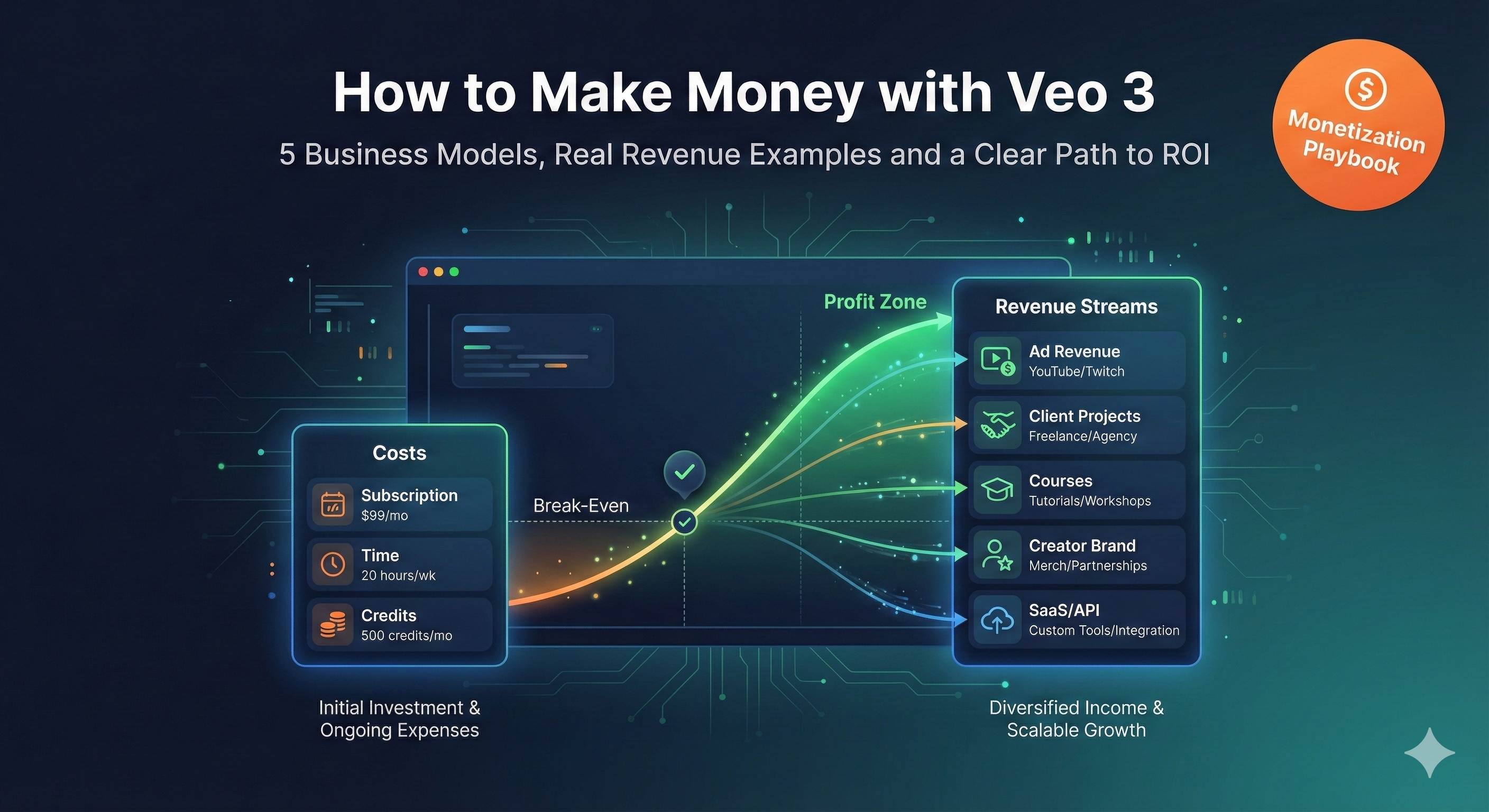
This article will break down 5 practical monetization paths, from the lowest barrier of platform revenue sharing to the most profitable knowledge products, to the long-term value of IP monetization. For each path, I’ll tell you: how much it costs, how much you can earn, and how to get started. Finally, I’ll do the math: how long does it actually take to earn back the subscription fee?
To be honest, not everyone is suited for full-time AI video creation. But if you want to find a reliable side hustle or are thinking about how AI tools can help increase your income, keep reading—you should find your answer.
Where Does Veo 3’s Commercial Value Lie?
Before talking about making money, we need to understand: why is Veo 3 worth this price?
Technical Advantage = Commercial Advantage
I did a little test. Using Veo 3 and several other AI video tools to generate content from the same prompt, I posted them on social media for voting. The result was clear: Veo 3’s videos scored higher on image quality, audio-video synchronization, and camera movement than most tools.
This isn’t technical bragging—it’s a real commercial advantage:
4K high-definition output means you can take on corporate promotional videos and government travel advertising. Clients don’t care what tool you use; they only look at the final delivery quality. Veo 3’s output looks good on big screens, which lets you charge higher prices.
Audio-video synchronization capability might sound like a small feature, but it’s crucial in practice. Look at those viral AI plot videos on Douyin and Kuaishou—the background music and visual rhythm sync perfectly, which is why users watch to the end. When completion rates go up, the platform gives you traffic, and that’s when revenue sharing kicks in.
Compare this to Sora—while it has 42% market share compared to Veo 3’s 38%—Sora’s commercialization moves are slower. OpenAI seems more focused on technical demonstrations, while Google opened Veo 3 directly to creators, dropping API prices from $0.75 to $0.4 (standard version) or $0.15 (Fast version) per second. This pricing strategy is clear: make it affordable so you can make money.
Early Adopter Benefits Still Exist
I joined several AI video creator groups and lurked for two weeks. One interesting data point:
A TikTok creator called impossibleais started making decompression videos with Veo 3 in November. After posting 17 videos, they gained 180,000 followers in 8 days. You might think this is an outlier, but I looked at domestic cases too—Douyin creator “Modern Little Hui” gained 21,000 followers and 77,000 likes with 15 videos.
Honestly, this follower growth rate is hard to imagine in traditional content creation.
Why is it still early enough to join? My observation: many people can use AI tools, but very few know how to make money with them.
Most people stay at the “showing off skills” stage—generating a flashy video, posting it on social media for a few hundred likes, and then… nothing. Those who actually convert traffic into income and works into orders are still the minority.
The market is also expanding rapidly. According to industry data, 86% of companies that deployed generative AI saw revenue growth, with an average increase of 6%. Kuaishou’s Kling (also an AI video tool) is projected to reach $150 million ARR in 2025, accounting for 20% of global market share.
What do these numbers tell us? AI video isn’t a bubble—it’s real business. Companies are willing to pay for this technology, users are willing to stay for this content, and platforms are willing to share revenue for this traffic.
So when you’re worrying whether “the AI video bonus period is over,” the reality is: the tool adoption period is over, but the golden age of monetization is just beginning.
People who understand technology are teaching others how to use tools, while people who understand business are already quietly making money. Let’s talk about how the latter do it.
5 Monetization Paths: Practical Breakdown
Path 1: Platform Revenue Sharing (Lowest Barrier)
This is the most direct way to make money: publish content on short video platforms and get paid based on views.
How exactly?
You post videos generated with Veo 3 on Douyin, Kuaishou, or YouTube Shorts. Platforms pay you based on views, completion rates, and engagement. No need to negotiate partnerships or find clients—as long as your videos get watched, you earn.
I carefully studied several cases of people making money through revenue sharing:
TikTok creator impossibleais specializes in “decompression videos”—content that’s comfortable and relaxing to watch. They used Veo 3 to generate 17 videos and gained 180,000 followers in 8 days. While they didn’t publicly disclose income, by TikTok’s creator fund standards, at this view level, monthly income is conservatively estimated at $5,000-10,000.
There are similar domestic cases. Douyin creator “Modern Little Hui” gained 21,000 followers and 77,000 likes with 15 AI-generated videos. Based on Douyin’s mid-video partner program revenue sharing ratio, monthly income should be around 3,000-8,000 yuan.
How much does it cost?
Subscription fee is the big one: Veo 3 Ultra is $124.99/month for the first three months (about 900 yuan), then $249.99/month from the fourth month (about 1,800 yuan).
Single video generation costs about 7 yuan (high-quality version). If you make 30 videos per month, that’s 210 yuan in costs.
Time cost: once proficient, a single video from concept to generation takes about 30 minutes to 1 hour.
How much can you earn?
This depends a lot on luck and topic selection. From my observations, creators producing 30-50 viral videos per month have a stable income range of 3,000-8,000 yuan.
If you reach the top tier (like impossibleais), breaking 10,000+ per month isn’t a dream. But honestly, this requires consistent output plus some luck.
Getting Started Tips:
- Choose the right niche: Cat plot videos, decompression videos, educational content, grandma plot videos—these are proven viral types
- Batch production: Don’t expect one video to go viral—you need volume to increase probability
- Study platform rules: Douyin and Kuaishou have different recommendation algorithms, TikTok has another set of rules
Risk warning: Pure traffic monetization has high uncertainty. When platform policies change or traffic drops, income can fluctuate dramatically. I suggest treating this as a starting method, not your only income source.
Path 2: Custom Service Orders (Quick Monetization)
If you can’t wait to slowly gain followers and want to see money quickly, taking orders is a more direct path.
How exactly?
Provide custom AI video services to companies, governments, and individuals. Clients give you requirements, you generate videos with Veo 3, and you get paid after delivery.
I searched Xianyu for “AI video customization” and found quotes ranging from tens to thousands of yuan. What’s the price difference? It mainly depends on service type:
- Corporate promotional videos: 1,000-5,000 yuan/video
- Travel advertising films: 2,000-8,000 yuan/video (government budgets are relatively generous)
- Product showcase videos: 500-2,000 yuan/video
- Emotional video customization: tens to hundreds of yuan (like adding motion effects to old photos)
Real cases worth noting:
A team called “Xiyang Stone,” three people collaborating, specializes in using AI tools to make travel advertising films for governments and companies. In 7 months, they earned 200,000+ yuan in revenue. Their orders range from 3,000-8,000 yuan each, averaging 5-8 orders per month.
There’s also a lighter order-taking approach—selling “AI revive old photos” services on Xianyu. Turn old photos provided by clients into dynamic videos with music, priced at tens to hundreds of yuan. Though the unit price isn’t high, it wins on volume and doesn’t require much communication cost.
How much does it cost?
The subscription fee is still the same price. But the main cost of custom services is time:
- Communicating requirements: 30 minutes to 1 hour
- Generating video: 1-3 hours (including multiple adjustments)
- Refinement and revisions: 1-2 hours
Per project, your time cost plus subscription fee is roughly 100-300 yuan.
How much can you earn?
This depends on what orders you take and how many.
If you focus on enterprise clients, high unit price but low frequency—5 orders per month at 2,000 yuan each = 10,000 yuan monthly income.
If you focus on individual clients, low unit price but high frequency—20 orders per month at 200 yuan each = 4,000 yuan monthly income.
The Xiyang Stone team of three earned 200,000+ yuan in 7 months, averaging about 10,000 yuan per person per month.
Getting Started Tips:
- Start by opening shop on Xianyu/Zhubajie: These platforms have large traffic, easier for beginners to get first orders
- Prepare a portfolio: First use Veo 3 to make 3-5 different types of videos to show clients
- Clarify service scope: Don’t take every order—focus on 1-2 types and do them well
The biggest advantage of custom services is: fast cash flow. You take orders this month, you can receive payment next month, without waiting for traffic to slowly build.
Path 3: Knowledge Products (High Profit)
If you’ve mastered Veo 3 techniques, why not teach others?
How exactly?
Sell AI video production courses, prompt templates, and methodology documents. There’s huge market demand—many people want to learn AI video but don’t know where to start.
I lurked in several knowledge-sharing communities and found diverse product formats:
- Pre-recorded courses: 199-999 yuan, one-time purchase for permanent access
- One-on-one private coaching: 3,000-5,000 yuan, providing personalized guidance
- Prompt template packs: 9.9-99 yuan, selling “ready-to-use” convenience
- Paid communities: 99-299 yuan/year, providing ongoing Q&A and resource updates
Real cases are quite impressive:
The Xiyang Stone team, besides taking orders, also built a community of over 5,000 people. Their private coaching course is priced at 5,000 yuan per person—50 people enrolled, earning 250,000 yuan from this alone.
There’s also an AI course creator called “Ye Pusa,” with courses priced 1,000-5,000 yuan, thousands enrolled. Exact numbers aren’t public, but conservatively estimated, annual income should be in the million-yuan range.
How much does it cost?
Course production time cost is the big one:
- Recording courses: 10-20 hours (if you can explain clearly)
- Creating supporting materials: 5-10 hours
- Q&A services: ongoing investment
Platform commissions also need consideration: Tencent Classroom, NetEase Cloud Classroom typically take 15-30%. If you build your own platform (like using Zhishi Xingqiu), commission rates are lower.
How much can you earn?
This varies enormously, depending on your pricing, student numbers, and repurchase rates.
Conservative scenario: course priced at 199 yuan, sold to 100 people, revenue 19,900 yuan (after platform commission about 14,000 yuan).
Optimistic scenario: course priced at 999 yuan, sold to 500 people, revenue 499,500 yuan (after commission about 350,000 yuan).
If you do private coaching, unit prices are higher. 5,000 yuan per person, serving just 10 people = 50,000 yuan revenue.
Getting Started Tips:
- First share free content on platforms: Xiaohongshu, Douyin, Bilibili—post free tutorials to accumulate followers and trust
- Start with low-priced products: First sell 9.9 yuan prompt packs to test market response, then launch high-priced courses
- Build a community: WeChat groups, Zhishi Xingqiu both work—maintain good relationships with old students, they’ll help refer others
The core of knowledge products is trust and repurchase. You must first prove you really know how to use Veo 3, then prove you can teach others, and only then comes payment.
Path 4: Self-Media IP Monetization (Long-Term Value)
The first three are about “selling products” or “selling services.” This one is about “selling influence.”
How exactly?
Build a personal IP, become a KOL in the AI video field, then monetize through brand deals, advertising, and product promotion.
This path takes longer but has a higher ceiling. Once you have a 10K, 100K follower account, income sources become very diverse:
- Brand deals: brands find you for promotion, charging thousands to tens of thousands per video
- Affiliate marketing/product promotion: recommend AI tools or related products, earn commissions
- Platform subsidies: creator support programs from Xiaohongshu, Douyin, etc.
Real cases:
Xiaohongshu creator “Tudou_man” mainly does AI tool reviews and creative videos. According to third-party data platform estimates, his single post sponsorship price is around 100,000 yuan, single video sponsorships can reach 300,000 yuan.
This is a top-tier case. Let’s look at mid-tier. The Xiyang Stone team, besides taking orders and selling courses, also spent time operating a 10K+ follower IP account. Though they haven’t publicly disclosed sponsorship income, by industry standards, 10K follower accounts should have monthly sponsorship income between 5,000-20,000 yuan.
How much does it cost?
Time is the biggest cost.
The first 3-6 months are basically investment period: producing content daily, slow follower growth, almost zero income. You need to endure this period.
Continuous content production costs aren’t low either: at least 3-5 posts per week, each post from planning to publication takes 2-3 hours.
How much can you earn?
This completely depends on your follower scale and account quality:
- 5,000-10K followers: 2,000-5,000 yuan monthly (mainly from platform subsidies and small sponsorships)
- 10K-50K followers: 5,000-20,000 yuan monthly (can now take brand deals)
- 50K-100K followers: 20,000-50,000 yuan monthly (quality sponsorships + product promotion income)
- 100K+ followers: 50,000-100,000+ yuan monthly (top KOL treatment)
Getting Started Tips:
- Vertical positioning: Don’t do everything—focus on one niche (like AI tool reviews, creative video tutorials, industry application cases)
- Consistent output: At least 3-5 posts per week to maintain account activity
- Engagement management: Reply to comments, participate in topics, build connections with users
The biggest characteristic of IP monetization is: slow start, explosive later. You need patience to get through the cold start period, but once it takes off, income becomes very stable.
Path 5: API/SaaS Services (Technical Barrier)
This is the highest barrier path but also the highest ceiling. Suitable for people with development skills.
How exactly?
Build a vertical domain video generation tool based on Veo 3’s API. For example:
- Real estate video generator: Input property photos, automatically generate property promotional videos with music
- E-commerce material tool: Input product images, generate short video ads
- Educational courseware tool: Convert PPT content into animated videos
You’re not teaching people how to use Veo 3, but packaging Veo 3’s capabilities into a “fool-proof tool” that even non-AI people can use.
Real case:
A foreign developer named Nico used AI technology to make a logo generator, launched in 48 hours, sold the project 3 months later for $65,000.
Though this case didn’t use Veo 3, the logic is the same: find a pain point scenario, quickly solve it with AI, then charge for it.
How much does it cost?
Technical cost: developing a simple web application, if you can code, time cost is 50-100 hours. If you can’t, outsourcing development costs 20,000-50,000 yuan.
Server and API fees: 1,000-5,000 yuan per month (depending on user volume).
Veo 3 API call fees: standard version $0.40/second, Fast version $0.15/second.
How much can you earn?
Business models generally come in three types:
- Monthly subscription: users pay monthly, like 99 yuan/month, 100 paying users = 10,000 yuan monthly income
- Pay-per-use: charge 5-20 yuan per video generated, 1,000 videos monthly = 5,000-20,000 yuan income
- Enterprise custom: provide private deployment to enterprises, charge 50,000-200,000 yuan per deal
Early-stage monthly income of 10,000-50,000 yuan is realistic; if the product is truly useful, mature stage monthly income of 100,000+ isn’t a pipe dream.
Getting Started Tips:
- Target specific scenarios: Don’t make an all-encompassing tool—focus on one pain point (like real estate, e-commerce)
- Quickly validate demand: First make a crude version, find 10 target users to test, confirm they’re willing to pay before refining
- Consider going overseas: Foreign users have stronger payment willingness; if your product solves pain points in overseas markets, income will be higher
This path isn’t suitable for most people, but if you have a technical background, it might be the most worthwhile direction to invest in.
Cost-Benefit Analysis: Can You Earn Back the Subscription Fee?
Alright, after reviewing 5 monetization paths, let’s do the math.
Cost Breakdown
Subscription fee (the big one):
- Veo 3 Ultra: first 3 months $124.99/month (about 900 yuan)
- From 4th month: $249.99/month (about 1,800 yuan)
- Veo 3 Pro: $19.99/month (about 145 yuan), limited to 3 videos per day
Single video generation cost:
- High-quality version: about 7 yuan/video
- If you produce 30 videos monthly, cost is 210 yuan
Time cost:
- Learning period: 1-2 weeks (depending on your prior AI tool experience)
- Single video production: 30 minutes to 2 hours (faster when proficient)
So first month total cost: 900 yuan (subscription) + 210 yuan (30 videos) = 1,110 yuan.
If you use full-price subscription from month 4, monthly cost rises to 1,800 yuan + 210 yuan = 2,010 yuan.
Break-Even Point Analysis
The key question: how long to earn back this 1,110 yuan?
Revenue sharing path:
Requires 30-50 viral videos monthly, with 3,000-8,000 yuan monthly income, you can profit in the first month. But there’s a prerequisite: you need to find the viral direction. Reality might require 2-3 months to consistently produce viral content.
Custom service path:
Taking 2-4 projects breaks even. At 2,000 yuan per project, 2 projects = 4,000 yuan income, minus 1,110 yuan costs, net profit 2,890 yuan. If you have order channels, you can profit as early as month 1.
Knowledge products path:
Selling 10-20 courses breaks even. If you sell 199 yuan courses, 10 sales = 1,990 yuan, after platform commission about 1,400 yuan, just covers costs. But prerequisite is you need a follower base first; cold start period might take 2-3 months.
IP monetization path:
This has the longest cycle. First 3-6 months are basically investment period, only costs no income. But once follower count grows, monthly income of 5,000-20,000 yuan, subscription fee becomes a non-issue.
API/SaaS path:
High development costs, but if the product works, payback is fast. 100 paying users × 99 yuan/month = 9,900 yuan, minus server, API, subscription fees of about 4,000 yuan, net profit 5,900 yuan.
My Decision Recommendations
If you’re a complete beginner (no followers, no order channels):
Suggest subscribing to Pro version ($19.99/month) first; 3 videos per day is enough for practice. Use Pro to validate whether you can create viral content, then decide after 1-2 months whether to upgrade to Ultra.
If you have order channels (done design, video, copywriting):
Go straight to Ultra, take the custom service path. This is the fastest way to break even. Month 1, take 2-3 orders and profit; month 2, you can simultaneously develop revenue sharing or knowledge products.
If you have teaching ability and follower base:
Ultra + knowledge products path. Create content to gain followers while selling courses. Should achieve positive cash flow within 3 months.
If you have technical background:
Ultra + API/SaaS path. High initial investment but highest ceiling. If you can validate the business model within 6 months, annual income of 100,000+ isn’t a dream.
Risk warning:
Don’t put all hopes on one path. The most stable combination is: revenue sharing (foundation) + custom service (quick monetization) + knowledge products (long-term income).
Also, don’t blindly upgrade to Ultra. If your monthly production is under 50 videos, Pro is enough—no need to spend 1,800 yuan on Ultra subscription.
3 Key Decisions for Quick Start
By now, you might be tempted. But don’t rush to subscribe—think through these three questions first.
Decision 1: What Type of Videos to Make First?
This is the most important decision. Choose the wrong direction and you might make dozens of videos with no views.
I researched AI videos that went viral on Douyin, Kuaishou, and TikTok over the past three months and found several proven viral niches:
Cat plot videos: AI-generated daily cat stories, healing content. Why viral? Because humans have no resistance to fluffy things.
Decompression videos: Visually comfortable content, like flowing water, clouds, light and shadow changes. TikTok’s impossibleais gained 180,000 followers in 8 days with this.
Educational content: Visualizing complex knowledge. Like historical events, scientific principles, health tips. This content performs particularly well in mid-video partner programs because completion rates are high.
Grandma plot videos: AI-generated grandma characters teaching life lessons or cooking. Strong emotional resonance, easy to trigger comments and shares.
How to choose?
Use this formula: Your interest × Market demand × Production difficulty
If you like cats, market demand is large, production difficulty isn’t high (single scene, no complex shots), then do cat plot videos.
If you understand history and can tell stories, do educational content. Though production difficulty is higher (need to research, write copy), fan loyalty is stronger.
Beginner recommendation: start with single scene, low complexity content. Don’t try to make blockbusters right away; first get the video generation process working.
Decision 2: Which Subscription Version?
This decision directly affects your cost structure.
Pro version ($19.99/month):
- 3 videos per day
- Suitable for: complete beginners, side hustle testers, uncertain if they can persist
- Advantages: low cost, bearable trial-and-error cost
- Disadvantages: limited output, hard to break even through revenue sharing
Ultra version ($124.99/month, first 3 months):
- 625 videos monthly (about 20 per day)
- Suitable for: people with clear monetization plans, ready for mass production
- Advantages: very low amortized cost, suitable for scaled operations
- Disadvantages: large upfront investment, will lose money if it doesn’t work
Decision formula:
Expected monthly output ÷ 30 = daily demand
If daily demand ≤3 videos, Pro is enough.
If daily demand >5 videos, go straight to Ultra.
If you’re between 3-5 videos, use Pro to validate for 1 month, confirm it’s working before upgrading.
My advice: don’t listen to “go all in from the start” chicken soup. First use Pro for 1 month to see if you can actually persist in daily content creation. Once you’ve truly created a few viral videos, upgrading to Ultra isn’t too late.
Decision 3: Solo or Team?
This decision affects your ceiling.
Solo advantages:
- Low cost: one person’s subscription fee + time cost
- High flexibility: do whatever you want without meeting discussions
- Suitable for side hustle: use spare time, doesn’t affect main job
Solo disadvantages:
- Low efficiency: from idea to publication all by yourself, easy to burn out
- Limited orders: large projects (like corporate videos) are hard to handle alone
- Easy to quit: no supervision, inconsistent effort
Team advantages:
- High efficiency: division of labor, some handle ideas, some production, some operations
- Can take large orders: corporate clients prefer teams over individuals
- Mutual encouragement: team atmosphere helps you persist
Team disadvantages:
- Cost sharing: though income is higher, must split with teammates
- Communication cost: need coordination when opinions differ
- Shared risk: if it doesn’t work, everyone loses
Xiyang Stone team case worth referencing:
They’re a 3-person team:
- 1 person handles ideas and copywriting
- 1 person handles video generation and post-production
- 1 person handles business liaison and operations
In 7 months, revenue 200,000+ yuan. Averaged per person per month about 10,000 yuan.
If you went solo, in the same 7 months, earning 50,000-80,000 yuan would be good (because your output and order-taking ability are limited).
My advice:
If you want a side hustle to test the waters, go solo. Risk is controllable, loss won’t hurt.
If you want full-time, scaled operation, find 1-2 reliable partners. Ideally complementary skills—like you do production, find someone good at operations; or you write copy, find someone technical.
Don’t form teams larger than 3 people. Too many people means communication costs are too high, not enough money to split.
Pitfall Prevention Guide: 3 Common Mistakes
After talking about making money, let’s discuss avoiding losses. These three pitfalls—many people have stepped in them.
Mistake 1: Blindly Pursuing Technical Perfection
I’ve seen too many people fall into this loop:
Spending three days repeatedly tweaking prompts to make cat fur more realistic;
Generating 50 versions of videos, agonizing over which camera movement is smoother;
Studying various advanced parameters to create “perfect” works.
Result? Not a single video published.
You think you’re pursuing excellence, but you’re actually procrastinating.
Truth is: users don’t care if your video is 100 points, they only care if they stay for 90 seconds.
impossibleais’s 17 viral videos—are the visuals exquisite? Okay, but not top-tier. Why viral? Because they posted fast and often, using quantity to increase probability.
Correct approach: publish first, iterate based on market feedback.
Make an 80-point video, spend 30 minutes, post it, check data. If views are good, replicate this model for mass production; if views are bad, quickly switch direction.
Don’t create in isolation. Your aesthetics don’t represent user preferences.
Mistake 2: Single Monetization Channel
Many people start excited: I’ll make short videos and earn money through revenue sharing!
After three months, gained 5,000 followers, monthly income 800 yuan.
Then they start questioning life: can this thing actually make money?
The problem isn’t that revenue sharing doesn’t work, but that you put all your eggs in one basket.
Platform recommendation algorithms can change anytime;
Viral directions can become outdated anytime;
Revenue sharing ratios can adjust anytime.
If you only rely on one income source, any change could zero out your income.
Correct approach: combined monetization (traffic + custom + knowledge products).
You post videos on Douyin for revenue sharing (baseline income);
Simultaneously list services on Xianyu for custom orders (quick monetization);
Meanwhile record courses to sell on Zhishi Xingqiu (long-term income).
This way, even if revenue sharing drops 50% this month, you still have custom service income as backup; even if orders decrease this month, you still have course income flowing in.
The Xiyang Stone team does exactly this: orders + courses + IP building, three-legged approach for stable income.
Mistake 3: Ignoring Copyright Risks
This pitfall is most hidden but can explode if triggered.
Someone used AI to generate celebrity likeness videos, millions of views, then got platform takedown + account ban;
Someone used popular music as BGM, took commercial orders, then got copyright complaints and paid tens of thousands in damages;
Someone created politically sensitive content, account permanently banned, months of effort wasted.
AI tools are powerful, but you bear legal risks yourself.
Correct approach:
- Primarily original content: design your own characters, scenes, stories—don’t directly imitate celebrities or IP images
- Confirm copyright for commercial use: if you take commercial orders, music and materials used must have commercial authorization
- Avoid high-risk areas: celebrities, politics, pornography, violence—stay away from these fields, platform review is extremely strict
My advice is: separate personal entertainment from commercial use.
For personal fun, posting to friends—use whatever materials. But if you’re taking commercial orders, creating paid content, you must ensure all elements have legal authorization.
Don’t take chances. One copyright dispute could cost you months of income.
Conclusion
Alright, after all this, let’s return to the original question: Can you earn back Veo 3’s subscription fee?
Answer: Yes.
But with three prerequisites:
- You chose the right monetization path: Based on your resources and strengths (time/skills/channels), choose the suitable path
- You’re willing to continuously invest: It’s not subscribe-and-earn-passively; first 1-3 months are basically investment period, you need to endure it
- You used the right methods: quick trial-and-error, combined monetization, avoid copyright risks
If you just want to test the waters, my advice is: first use Pro version ($19.99/month) for 1 month, set a small goal—create 10 works or land the first order.
If you complete this goal this month, proves you’re serious and have execution power, then upgrade to Ultra, choose 1-2 monetization paths to dive deep.
If you don’t complete this goal this month, don’t waste money. Not everyone is suited for content creation—admitting this isn’t shameful.
Final honest words: AI tools are just amplifiers; what really determines income is business model and content quality.
Veo 3 won’t suddenly turn someone who can’t tell stories into a viral creator, nor will it automatically make someone without business thinking earn money. What it can do is turn what previously required a team + equipment + tens of thousands in costs into something one person + one computer + a few hundred yuan can accomplish.
The barrier lowered, opportunity arrived.
The rest depends on you.
Published on: Dec 7, 2025 · Modified on: Dec 15, 2025

Related Posts

Complete Guide to Veo 3 Audio Generation: How to Add AI Voice and Music to Videos (With Prompt Templates)
The Complete Guide to Veo 3 Character Consistency: Creating Coherent Multi-Shot Videos with Scenebuilder
Comments
Sign in with GitHub to leave a comment