
Content Monetization Paths Compared: Ad Networks, Affiliate Marketing, or Digital Products?
The creator economy reached $23.4 billion in 2026—an impressive figure. But here’s the more sobering reality: over half of creators earn less than $5,000 annually.
It’s not a traffic problem. I’ve seen blogs with tens of thousands of monthly views and solid content that still struggle to make money. The real issue? Choosing the wrong monetization path.
Some creators stick religiously to AdSense, fretting over a few dollars each month. Others blindly fill their articles with affiliate links that nobody clicks. Then there are those who jump straight into selling courses without ever validating their audience’s willingness to pay.
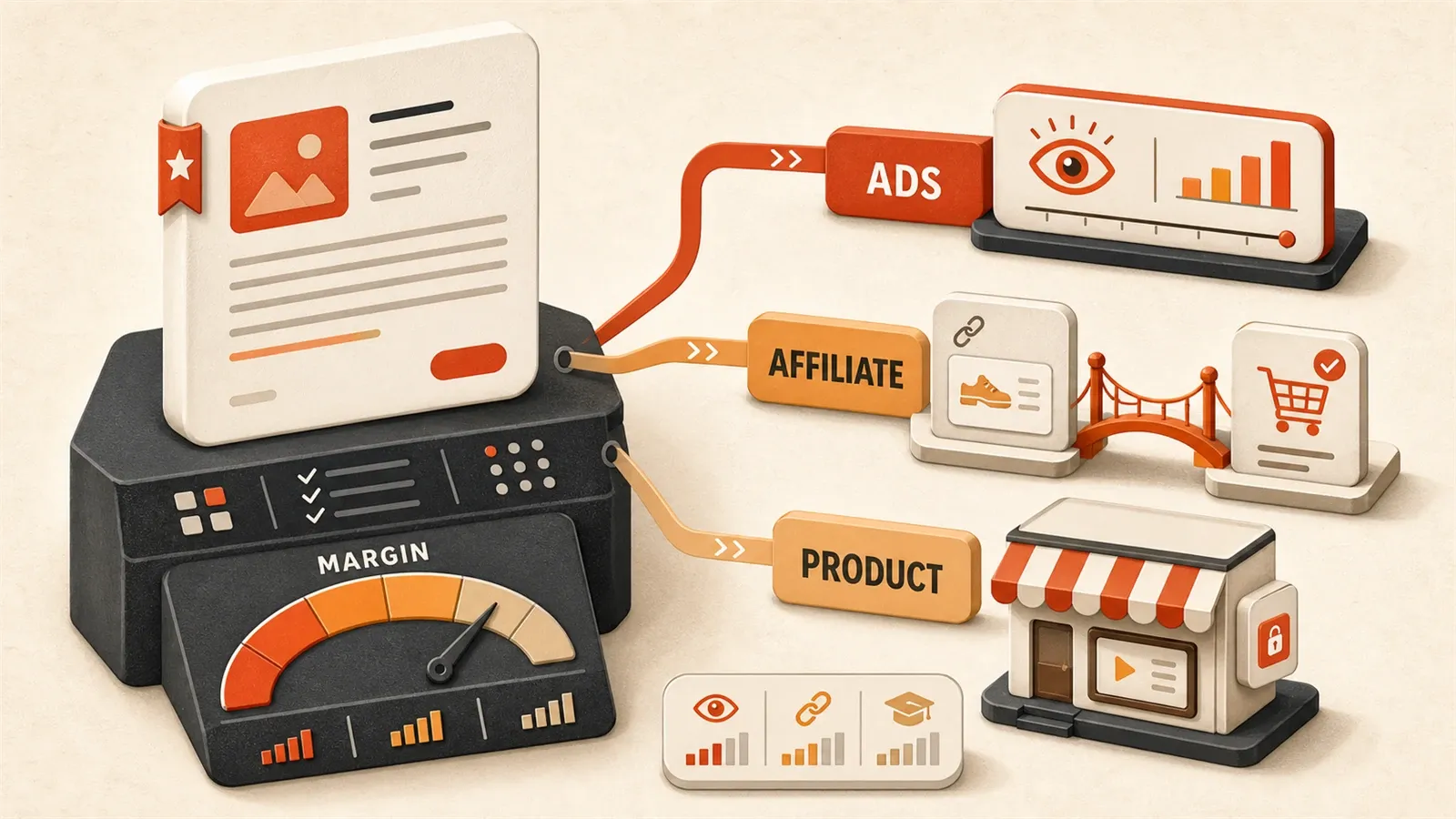
The truth is, each of these three monetization paths has its own use case—none is inherently superior. Ad networks work best for sites with steady traffic but content that doesn’t directly drive purchases. Affiliate marketing suits review content that influences buying decisions. Digital products require professional expertise and an audience foundation built on trust.
In this article, I’ll lay out the key data for all three paths and provide a decision framework. By the end, you’ll have a clear sense of which path to start with based on your current traffic and content type.
1. Ad Networks — The Foundation for Passive Income
Ad networks represent the most “hands-off” monetization approach: you add code, advertisers place ads, readers see them, you get paid. Global ad spend is projected to exceed $1 trillion in 2026—that’s a substantial pie.
But a big pie doesn’t guarantee you’ll get a meaningful slice.
Let’s look at the numbers: Google AdSense RPM (revenue per thousand views) typically ranges from $3 to $10. Mediavine achieves $15 to $40, while Raptive goes even higher at $20 to $60. For the same 100,000 views, AdSense might pay you $300, while Mediavine starts at $1,500—a 5x difference.
Honestly, many beginners stick with AdSense not because it performs well, but because they don’t know better alternatives exist. Ezoic has no traffic threshold and delivers 50% to 300% higher earnings than AdSense. I know a blogger who switched from AdSense to Ezoic—monthly income jumped from $80 to $260 with zero traffic change.
Ad networks have low barriers to entry: AdSense has virtually no traffic requirements—just compliant content. But Mediavine requires 50,000 monthly sessions, and Raptive needs at least 25,000 pageviews. The progression looks like this:
Entry Level → Transition Level → Premium Level
AdSense (no threshold) → Ezoic (no threshold) → Mediavine/Raptive (thresholds apply)
What content suits ad networks? General-purpose content. If you write lifestyle essays, travel guides, or food tips—readers consume and leave without clear purchase intent—ad networks are ideal. Since readers won’t buy anything anyway, at least ads generate some income.
Conversely, if your content naturally drives purchases (like tech reviews or skincare recommendations), ads become disruptive. A reader ready to click your affiliate link gets distracted by a banner ad—poor experience.

Common pitfalls: Many assume more ads equal more revenue. Wrong. Too many ad placements drag down RPM and degrade user experience. Ezoic offers smart ad testing to find the balance between revenue and experience—use it.
Also, don’t fixate on USD. If your primary audience is in China, AdSense Chinese ad RPM is significantly lower than English. Consider domestic ad platforms—while unit prices might be lower, conversion rates could be higher.
2. Affiliate Marketing — Commission Model Driven by Conversions
The logic is straightforward: you recommend products, readers buy, you earn commissions.
Here’s an interesting 2026 data point: creators doing affiliate marketing plus diversified monetization earn an average of $8,038 monthly. Those relying solely on display ads earn notably less. This gap reveals a crucial insight—affiliate marketing has higher upside than ad networks.
Commission rates vary dramatically. Amazon Associates is the most common entry point, but commissions aren’t great. Most categories offer just 1% to 4%, luxury beauty reaches 10%, and games top out at 20%. Sell a $2,000 gaming console, you earn $400 commission. Sell a $20 book, you might get just pennies.
Platforms like ShareASale offer broader commission ranges—4% to 50%—across more than 25,000 merchants. Knowledge products typically offer 30%+ commissions. Sell a $200 online course, you could earn $60.
What content suits affiliate marketing? Content that influences purchase decisions. Reviews, tutorials, recommendation lists, comparison articles. Write “Best Noise-Cancelling Headphones of 2026,” list 5 products with affiliate links, and readers actively shopping will click through and buy.
Here’s the key: content relevance. A food blog stuffed with tech product links won’t convert. Similarly, a tech blog recommending kitchen appliances won’t perform well. Affiliate links must appear where readers are already in a buying mindset.
The barrier to affiliate marketing isn’t traffic—it’s trust. A blogger with a few hundred followers, producing professional and sincere content, can achieve higher conversion rates than accounts with tens of thousands of followers. I’ve seen a coffee review blogger with under 3,000 followers whose detailed reviews—showing brewing processes, recording flavor changes, comparing different beans—drove immediate purchases. Her affiliate income exceeded generic entertainment accounts.
2026 affiliate marketing shifts: Many platforms introduced automation tools. Amazon’s Programmatic auto-recommends relevant products. ShareASale has AI content suggestions. These tools help you find suitable products to promote, saving manual screening time.
Common pitfalls: The biggest mistake is stuffing links. Some bloggers fill every article with affiliate links under “recommendation” headlines, but content is hollow and unconvincing. Readers immediately spot the soft ad and won’t click.
Another issue: Amazon’s cookie is only 24 hours. If a reader clicks your link but doesn’t buy within 24 hours, you lose the commission. Other platforms have longer cookies—ShareASale varies by merchant, some lasting 30 days. Understand each platform’s rules to avoid losing commissions.
3. Digital Products — High-Margin Value Monetization
Digital products deliver the highest profit margins among the three paths. Selling your own courses, ebooks, newsletters, templates—no middlemen taking cuts, you control pricing entirely.
The knowledge economy surpassed 380 billion RMB in 2026 (approximately $52 billion). That’s a significant market. Online courses, ebooks, and AI-powered products are listed as this year’s most profitable digital product types.
Newsletter monetization has practical data: Email subscribers generate an average of $1 per month. 1,000 subscribers roughly equals $1,000 monthly. ConvertKit platform data shows creators with email lists have more stable income than those without.
Course income varies widely. Platforms like Teachable and Kajabi host creators selling everything from courses priced at tens of dollars to comprehensive series costing hundreds. TikTok education creators posting 5+ Shop-tagged videos monthly earn $800 to $3,200.
Platform costs: Xiaoetong Professional edition costs 12,800 RMB annually (about $1,800), Standard edition 6,800 RMB (about $940). Knowledge Planet is community-focused, with annual revenue in the hundreds of millions—proving market demand exists. These platforms suit creators with established follower bases looking to build private traffic pools.
What content suits digital products? Professional knowledge that can be systematized. If you’re skilled in a tech stack, consolidate scattered blog posts into a comprehensive course. If you understand financial planning, create an ebook or paid newsletter.

The biggest difference from the first two paths: you need followers willing to pay. Ad networks generate income from views alone. Affiliate marketing earns commissions from conversions. Digital products require readers to recognize your professional value and pay for your content.
Barriers to digital products: Longest ramp-up time. Creating a course might take 3 to 6 months. Writing an ebook also requires substantial time investment. Initial costs are also high—Xiaoetong annual fees exceed 10,000 RMB, and while Teachable offers free start, it takes commissions.
2026 digital product trends: Newsletter monetization is a hot direction. Many creators expand from a single newsletter to multiple revenue streams—paid subscriptions, course promotions, affiliate links, brand partnerships. One piece of content can trigger multiple monetization points.
Common pitfalls: The biggest mistake is starting with a massive course. I’ve seen creators spend six months building a complete course, only to price it at hundreds of dollars with zero sales—they never validated willingness to pay.
A safer approach: start with small product tests. A $19 mini-course or a $9 ebook template. Small products help you validate: will followers actually pay? If small products don’t sell, don’t build big ones.
4. How to Choose Your Monetization Path?
With all that said, which should you choose?
First, let’s examine this comparison table with key metrics for all three paths:
| Evaluation Dimension | Ad Networks | Affiliate Marketing | Digital Products |
|---|---|---|---|
| Traffic Threshold | 10K+ views/month to start | No hard threshold, needs trust foundation | Followers need willingness to pay |
| Skill Threshold | Consistent content production | Conversion copywriting skills | Systematized output capability |
| Revenue Ceiling | RPM has ceiling | High commission potential | Highest profit margins |
| Ramp-up Time | 1-3 months to see results | Start immediately | 3-6 months preparation |
| Investment Cost | Nearly zero | Nearly zero | Medium to high |
| Suitable Content | General-purpose content | Reviews/recommendations | Professional knowledge output |
This table helps you quickly judge which direction fits. But real-world application isn’t that simple—your audience size, content type, and time availability all influence the choice.
My recommendation: stage-based approach by audience size
Starting Stage (under 5,000 followers): Start with affiliate marketing.
Why? Ad networks need traffic foundations. A site with a few thousand followers might generate only a few dollars monthly from ads—the ROI isn’t worth it. Digital products have even higher barriers since you haven’t validated willingness to pay.
Affiliate marketing has no hard traffic threshold. As long as your content influences purchase decisions, a few hundred followers can generate conversions. More importantly, affiliate marketing builds trust—readers buy products you recommend, find them useful, and return to your content. This process tests audience stickiness.
Growth Stage (5,000 to 50,000 followers): Run ad networks and affiliate marketing in parallel.
At this traffic level, ad network revenue becomes meaningful. Over 10,000 monthly views, start with AdSense, then upgrade to Ezoic or Mediavine when you hit thresholds.
Continue affiliate marketing simultaneously. Running both paths lets you compare: for the same traffic and content, which monetization generates higher returns? You’ll only know by testing yourself.
Mature Stage (over 50,000 followers): Layer in digital products.

With stable traffic and established audience trust, start building digital products. Your content has already validated value, so followers are more likely to pay.
But don’t rush into big courses. Test with small products first—$19 mini-courses, $9 ebook templates. Gauge purchase feedback before deciding whether to invest in larger products.
Three things to absolutely avoid:
First, don’t settle for just AdSense with ad networks. Once you hit traffic thresholds, upgrade platforms immediately. Ezoic has no threshold and pays 50% to 300% more than AdSense—not knowing this means leaving money on the table.
Second, don’t stuff unrelated products in affiliate marketing. Content relevance determines conversion rates. A food blog recommending tech products, or a tech blog recommending kitchen appliances—readers won’t buy. Affiliate links must appear where readers are already in a buying mindset.
Third, don’t start digital products with a massive course. Without validating willingness to pay, investing six months could mean total loss. Test with small products first—if they don’t sell, don’t build big ones.
Combination strategy is king: These three paths aren’t mutually exclusive—they stack. Many mature creators use ad networks as foundation, affiliate marketing for primary profit, and digital products for brand premium. You don’t need to start all three simultaneously, but the end state is likely a combination.
Summary
Three monetization paths, each with distinct value in one sentence:
Ad networks are the foundation for traffic monetization—lowest barrier, slowest results, ideal for passive income on general-purpose content. Affiliate marketing is a commission model driven by conversions—low traffic threshold but requires trust foundation, suits content that guides purchase decisions. Digital products are the high-margin option for value monetization—highest profit margins but longest ramp-up, suited for creators with systematization capabilities.
What’s your next step?
Evaluate your audience size and content type. Under 5,000 followers? Start with affiliate marketing to build trust. Tens of thousands? Run ad networks and affiliate marketing in parallel for testing. Over 50,000? Begin small product tests to validate willingness to pay.
Monetization isn’t a pick-the-right-one-and-earn-passively path. Each requires time to build—ad networks need traffic, affiliate marketing needs trust, digital products need expertise and paying customers. But at least choosing the right starting point saves considerable detours.
FAQ
Which monetization method should beginners start with?
Should I choose AdSense or Ezoic for ad networks?
What are typical affiliate marketing commission rates?
How many followers do I need to create digital products?
Can I do all three monetization methods simultaneously?
How effective is newsletter monetization?
How do I match content type to monetization method?
10 min read · Published on: Apr 28, 2026 · Modified on: Jul 30, 2026

Content Marketing Complete Guide
If you landed here from search, the fastest way to build context is to jump to the previous or next post in this same series.
Previous
Tech Blog Monetization in Practice: Revenue Breakdown of Ads, Courses, and Communities
A detailed breakdown of real revenue data across three mainstream monetization paths for tech blogs. From ad RPM to course pricing strategies, use data to find your best path.
Part 23 of 26
Next
High Impressions, Low Clicks? A Weekly GA/GSC Operations SOP for Tech Blogs
Diagnose and optimize the high impressions, low clicks problem for tech blogs. This 30-minute weekly GA/GSC operations SOP includes CTR benchmarks, problem page identification, headline rewrite formulas, and automation solutions. Features real-world data, n8n workflow configurations, and acceptance criteria.
Part 25 of 26


Comments
Sign in with GitHub to leave a comment