
Content Repurposing Strategy: How to Turn One Long Article into 10 Short Video Scripts
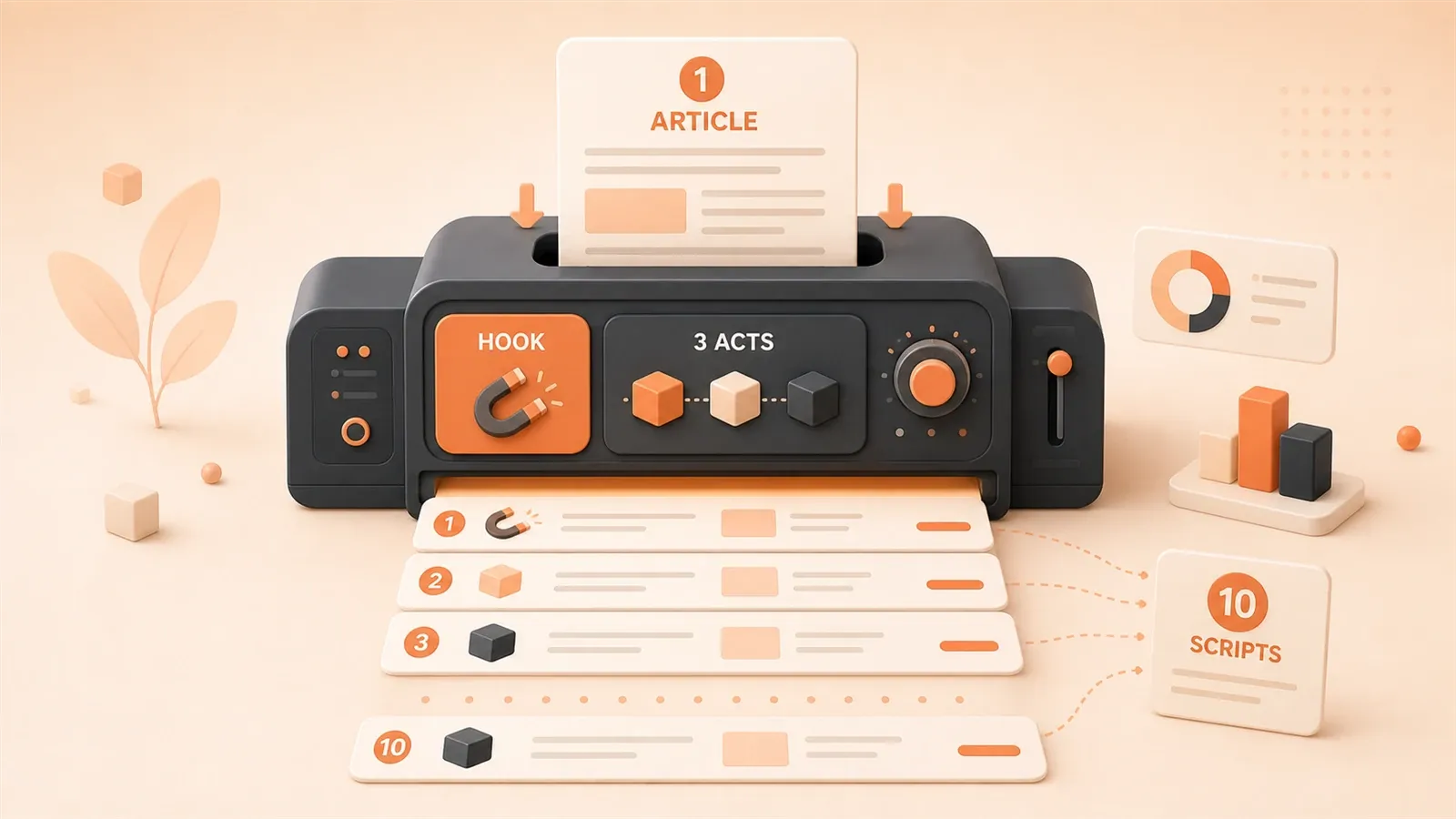
A reader asked: “I have a 3,000-word post I want to turn into short video, but I don’t know where to start. Writing took three days; scripts have me stuck for two more.”
I have heard that at least twenty times.
The numbers from one post: 800 reads on the long article, 1.2M+ views after ten short clips. Completion rate went from about 8% to 25%—roughly triple.
“Breaking scripts” is not slicing paragraphs and adding B-roll. My first try had 70% three-second drop-off and under 10% completion. The fix is rebuild: skeleton, flesh, then hook.
This article is the full workflow—mistakes included.
Why Breaking Long Articles into Short Videos Improves Efficiency and Results?
I roughly calculated: writing a 3000-word article — from topic selection, research, writing to revisions — takes at least 3 days. Published results? Luck gives you a few thousand views, bad luck gives you hundreds. ROI-wise, honestly, it’s crushing.
But the same article, broken into 10 short videos, means 3 days yields 10 pieces of content. According to some data, systematically restructured content boosts completion rates by 34% and engagement by 28%. This isn’t magic — it’s because short video recommendation algorithms work differently from long articles. Articles rely on search and shares; videos rely on completion and engagement.
One more thing: a single article can go to Douyin, Xiaohongshu, Bilibili, even become image-text posts for official accounts. Foreigners call this “content atomization” — one core asset, split into dozens of formats, maximizing ROI.
So the question is: exactly how do you break it down?
The Three-Step Method: A Standardized Process from 3000 Words to 10 Scripts
Step 1: Break the Skeleton (Structure Layer)
Open your article, don’t rush into scripts. Grab a pen and mark the core paragraphs: opening hook, key points, cases, conclusion. Like dismantling a house — find the load-bearing walls first.
Then evaluate information density. Which are “high-value fragments”? Data, memorable quotes, real cases — keep these. Which are “transition content”? Filler fluff — throw it away.
One important point: mark emotional nodes. Where in the original text surprises people? Where creates resonance? Where touches hearts? These emotional peaks are the “explosive points” for short videos.
Example: my Git efficiency article, originally 3000 words, the truly valuable core content was about 1500 words. After breaking: first script covers “why your git commits are always wrong,” second covers “3 config commands to double your efficiency,” third covers “pitfalls I stepped into that you should avoid”…
Step 2: Strip the Content (Material Layer)
Skeleton ready, next is visuals.
Match visual presentation for each core point. Data content fits comparison charts, bar graphs; case content fits live footage + subtitles; emotional content fits close-up shots + music.
Then sound effects and music. Mark emotional transitions with sound suggestions. Like: “add a [ding] sound effect here,” “background music gets tense here.”

The most critical step: rewrite dialogue into conversational style. Formal language becomes “chatting with close friends” style. Original says “Git configuration is a key factor in improving efficiency,” script becomes “honestly, I’ve seen way too many people using git wrong, efficiency so low you wouldn’t believe.”
After rewriting, read it aloud. Must flow naturally.
Step 3: Inject Soul (Original Restructuring)
At this point, scripts are formed. But there’s one more pitfall: copyright issues.
Original restructuring has 5 check points: name substitution (change Zhang San to Li Si), location substitution (change Beijing to Shanghai), quote rewriting (same meaning, different wording), case adaptation (keep core, rewrite details), data re-expression (present differently).
Platform adaptation matters too. Douyin needs fast pacing, 15-40 seconds mainly; Xiaohongshu needs refined aesthetic, warm-toned visuals; Bilibili can go deeper, 1-3 minutes works fine.
I usually use a checklist: does this script have my own viewpoint? Is there scenario-based adaptation? Is the narrative angle right? All three pass, then it’s “soul injected.”
The Golden 3-Second Hook: Capturing Users in the First 3 Seconds
Here’s some scary data: over 70% of users decide within the first 3 seconds whether to keep watching your video. If the first 3 seconds don’t hold them, everything after is wasted.
The hook’s core logic is simple: conflict upfront, benefit promised. Plainly: break the user’s cognitive balance, then tell them “what you’ll get by watching.”
I summarized three directly usable hook formulas:
Formula 1: Counter-Intuitive Question + Benefit
“Why do harder-working people get promoted slower? 90% fall into this trap — watch to save 3 years of wrong turns.”
Counter-intuitive question creates cognitive conflict, benefit gives clear takeaway feeling.
Formula 2: Conflict Scenario + Solution
“Boss says ‘good work,’ don’t reply ‘not hard’ anymore! 3 high-EQ responses to fast-track your promotion.”
Conflict scenario triggers resonance, solution gives action path.
Formula 3: Data Shock + Promise
“One long article turned into 10 short videos, over 1 million views! I’ve used this method for 2 years, breaking it down for you today.”
Data shock builds credibility, promise previews content value.
Formula ready, execution has three elements: visual, text, sound. Opening visuals must have impact — contrast, reversal, exaggeration all work. Subtitles appear in first 3 seconds, reinforcing hook message. Tone variation配合 sound effects, like a “ding” signaling key points.
When I first used formula 3, 3-second bounce rate dropped from 70% to 35%. Just this one change, the entire video’s completion rate doubled.
Three-Act Structure Template: The Universal Framework for 15-40 Second Videos
Hook handled, next is body structure.
I usually use three-act structure for short videos: Act 1 throws pain point, Act 2 explains method, Act 3 creates interaction.
Act 1 (0-15 seconds): Throw Pain Point or Surprise Promise
No setup, serve directly.
“Have you encountered this: spent 3 days writing an article, only got a few hundred views?”

Or use surprise promise:
“Today I’ll teach you a method — one article can yield 10 viral videos.”
This 15 seconds has one task: make users feel “this video relates to me.”
Act 2 (15-35 seconds): Core Method Display
Cover only 1 main method, don’t overreach. Overreach kills.
Expand with “step 1, 2, 3,” or use “mistake vs correct approach” contrast.
“Actually just three steps: first, break skeleton, find core paragraphs; second, strip content, match visuals and dialogue; third, inject soul, add your viewpoint.”
This 20 seconds’ task: make users feel “I learned something.”
Act 3 (35-40 seconds): Summarize Value + Interaction Hook
Memorable phrase + action call.
“Remember this formula: hook + method + interaction. Comment section tell me your problem, I’ll help break it down.”
This 5 seconds’ task: make users feel “want to act.”
Emotional rhythm roughly: start curious → middle learned/agreed → end resonated/want to act. Like a song: intro grabs, chorus peaks, outro echoes.
I’ve seen many beginner scripts: Act 1 over-setups, Act 2 stuffs three-four methods, Act 3 unclear about what to do. Result: tragic completion rates.
Remember: one script serves one core goal. More is less.
Multi-Platform Adaptation: Douyin, Xiaohongshu, Bilibili Are Different
Same script, different platforms, results can vary wildly.
Douyin Adaptation
Douyin’s core is “fast.” 15-40 seconds mainly, information density at 0.8-1.2 key points per second. Too fast users can’t follow, too slow users get bored.
Hook must be strong, first 3 seconds need visual impact or suspense. Ending must have interaction guide — “tell me in comments,” “like and save for later.”
Douyin users scroll videos like drinking water, one after another. If your video doesn’t grab them in the first second, next second they swipe away.
Xiaohongshu Adaptation
Xiaohongshu needs “refined aesthetic.”
Visual tone偏暖, filters gentle, overall “lifestyle” feeling. Tech content needs packaging as “efficiency tools,” “life hacks.”
Titles matter: number + emotion word. “3 methods to double efficiency,” “5 pitfalls I hit, help you avoid.”
Xiaohongshu users lean female, aesthetic standards high. Rough videos won’t perform well there.
Bilibili Adaptation
Bilibili can go “deeper.”

Videos can extend to 1-3 minutes, adding background knowledge and principle explanations. Users willing to spend time on干货.
Address differently: use “UP主,” “同学” these community expressions. Bullet screen interaction can preset trigger points — “see here send 666.”
Bilibili users sticky, willing to watch long content. But前提 is content truly valuable, not padding time.
I’ve posted to all three, same script: Douyin 1 million views, Xiaohongshu 300k, Bilibili 150k. Not Bilibili weak, content adaptation different. Douyin version I compressed rhythm tight, Bilibili version I added lots of background explanation.
AI Tool Recommendations: ChatGPT, Pictory, VEED Comparison
Honestly, script breaking, AI tools save you lots of time.
ChatGPT
Advantage: free, flexible, customizable prompts. For script rewriting, conversational adjustment, hook design, works well.
But缺点: manual operation required, can’t auto-generate video. Script done, still need to find visuals, voiceover yourself.
Pictory
One-stop solution: script to video, auto-matches visuals, AI voiceover. Suitable for rapid批量 production.
But it’s付费, monthly fee几十 USD. Visual matching sometimes不够精准, needs manual adjustment.
VEED
Online editing, templates丰富, team collaboration friendly. Suitable for多人协作, multi-platform publishing.
But automation level不如 Pictory, needs更多 manual adjustment.
My suggestion: first use ChatGPT for scripts (free), then use VEED or CapCut for editing (free or low-cost). Pictory适合 budget充足, need批量 production的 teams.
Tools just辅助. Core还是 your content quality and script structure. Tools再好, content不行, results白搭.
Summary
Said这么多, core actually就一套流程: three-step method — break skeleton, strip content, inject soul; golden 3-second hook formula — counter-intuitive question, conflict scenario, data shock; three-act structure — pain point, method, interaction; multi-platform adaptation — Douyin fast, Xiaohongshu refined, Bilibili deep.
Copyright avoidance记住那5个检查要点: names, locations, quotes, cases, data, all re-express.
Next step what to do? Take your most recent article, follow本文的流程, break out first short video script. Just one, try it first.
Comment section tell me your biggest difficulty — is breakdown不知道从哪开始, or hook design没有灵感, or platform adaptation搞不清楚. I’ll help break it down.
Three-Step Method for Breaking Long Articles into Video Scripts
A standardized process to convert a 3000-word article into 10 short video scripts
⏱️ Estimated time: 60 min
- 1
Step 1: Break the Skeleton (Structure Layer)
Open the original, mark core paragraphs:
• Opening hook, key points, cases, conclusion
• Evaluate information density: keep high-value fragments (data, quotes)
• Mark emotional nodes: surprise, resonance, touching points
• Throw away transition fluff - 2
Step 2: Strip the Content (Material Layer)
Match visual presentation for each core point:
• Data type → comparison charts, bar graphs
• Case type → live footage + subtitles
• Emotional type → close-up shots + music
• Dialogue conversational rewrite: "chatting with friends" style
• Read aloud once, ensure flows naturally - 3
Step 3: Inject Soul (Original Restructuring)
Copyright avoidance 5 check points:
• Name substitution (Zhang San → Li Si)
• Location substitution (Beijing → Shanghai)
• Quote rewrite (same meaning, different wording)
• Case adaptation (keep core, rewrite details)
• Data re-expression (present differently)
• Platform adaptation: Douyin 15-40s, Xiaohongshu refined, Bilibili 1-3min
FAQ
How many video scripts can one long article yield?
Will script breaking have copyright issues?
• Name, location substitution
• Quotes: change wording, keep meaning
• Cases: keep core, rewrite details
• Data: present differently
Follow these to avoid direct copying issues.
How to choose from the golden 3-second hook formulas?
• Counter-intuitive question + benefit → content that breaks cognition
• Conflict scenario + solution → workplace, life hacks
• Data shock + promise → content with real data backing
Choose the formula closest to your content characteristics.
How to adapt one content for Douyin, Xiaohongshu, Bilibili?
• Douyin → 15-40s, fast-paced, strong hook
• Xiaohongshu → refined aesthetic, warm tones, number + emotion word titles
• Bilibili → 1-3min, can go deep, use community expressions
Don't post one script directly to all three platforms.
Can AI tools replace human script breaking?
8 min read · Published on: May 5, 2026 · Modified on: Jul 14, 2026

Content Creation
If you landed here from search, the fastest way to build context is to jump to the previous or next post in this same series.
Previous
Writing Takes 3 Hours? My AI Workflow Cuts It Down to 30 Minutes (With Prompt Templates)
From topic selection to first draft in just 30 minutes! Complete AI-assisted writing workflow with 4-step method, 4 practical prompt templates, mainstream tool comparison, and techniques to remove AI tone. Boost your writing efficiency by 75% immediately.
Part 3 of 6
Next
Can Technical Content Go Viral? 5 Emotional Hooks That Make Developer Articles Spread
Can technical content go viral? This article shares 5 emotional hook design methods, 10 ready-to-use copywriting templates, and cross-platform distribution strategies to make technical articles spread.
Part 5 of 6


Comments
Sign in with GitHub to leave a comment