
Cloudflare Pro vs Business: A Three-Dimensional Decision Tree to Judge Upgrade Timing
You’ve been running on Cloudflare Pro for six months, traffic growing from 100K PV/month to 500K. Analytics occasionally shows a few red WAF alerts that disappear before you can look closely. Your boss suddenly asks: “The $200/mo Business plan—should we upgrade?”
There’s no standard answer to this question. The gap between Pro and Business isn’t just a few lines on the pricing page—it’s capability boundaries in real-world scenarios.
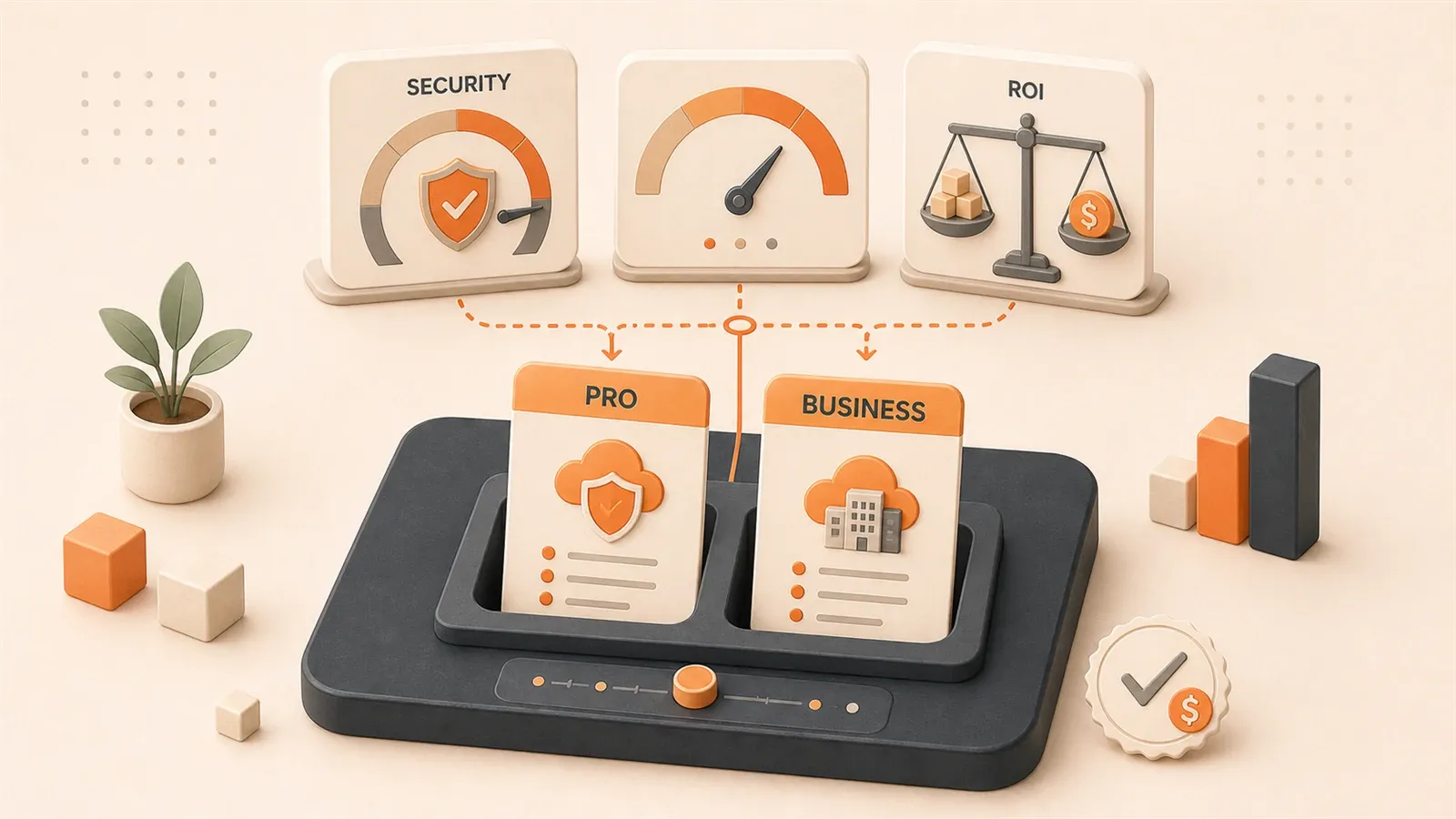
This article won’t give you a feature comparison table. Instead, it provides a decision framework—from security, performance, and cost dimensions to help you judge: is upgrading now premature budget waste, or missing a compliance window?
The core question in one sentence: How far can Pro go, and when is Business’s $200 really worth it?
Security Dimension — Is Your Pro Plan Enough?
Let’s talk security first. This is what most people considering an upgrade think about first.
WAF Rule Count: Is 20 Enough?
Pro gives you 20 custom WAF rules, Business has no explicit limit (official docs say “more”). Sounds like a big gap, but you need to ask yourself: do you really need that many rules?
20 rules cover most common scenarios: SQL injection blocking, path filtering, IP blacklist, country blocking. If your site isn’t a high-value attack target (like finance, healthcare, government), 20 rules are probably enough. I’ve seen sites run Pro for three years with only 8 WAF rules used—the other 12 never touched.
But if your business involves user payments or sensitive data storage, things change. One successful SQL injection could cause user data breach, compliance fines plus brand damage far exceeding the $200/mo budget. A few more rules, another layer of protection, could be the difference between an incident and nothing.
Bot Management: The Key Difference Between Pro and Business
This is the real dividing line.
Both Pro and Business include Super Bot Fight Mode; it is not Business-only. Pro already provides Bot Report categories such as automated traffic, likely automated traffic, verified bots, and human traffic, and can challenge or block clearly automated requests.
Business is valuable when you need finer security correlation: richer security analytics, Bot classification, and the WAF Attack Score Class field available on Business let you combine “likely automated” and “likely attack” signals in one rule strategy.
The key difference is not whether Bot protection exists; it is how precisely you can classify and act on traffic. If SEO traffic matters, you may want verified search engines allowed while price scraping, credential stuffing, and abnormal API access are suppressed. Business gives you more room to express that policy.

Upgrade triggers are simple:
- Bot attack frequency exceeds 5/month, each causing real impact (server degradation, slow response)
- You need fine-grained Bot type distinction (allow search engines, block crawlers)
- You need WAF Attack Score Class, the attack-score classification field available on Business, to judge request risk level
If none of these three hit, Pro’s Super Bot Fight Mode is usually enough. No need to upgrade early.
Real Attack Scenario: When Pro Can’t Hold
Let me share a real case. An e-commerce site used Pro, traffic stable, WAF alerts occasional but no impact. One night at 3 AM (not a cliché, real timing), a distributed Bot started mimicking human requests—200 concurrent per second, spread across 50 IPs. Pro’s frequency detection threshold was default, didn’t trigger. The Bot successfully scraped all product prices and inventory data, uploaded to a competitor analysis platform.
Next day, operations found sales crashed, users moved to competitors. During the post-mortem, they found WAF had alerts, but because the Bot mimicked human behavior so well, rules didn’t block it. After upgrading to Business, the team combined Bot classifications, abnormal request traits, and WAF Attack Score Class in rules: abnormal HTTP header order, very short JavaScript execution time, and risky attack-score class were challenged or blocked.
This case shows one thing: Pro’s security capability has boundaries, Business is another layer of protection. If your business being scraped once causes real loss, upgrade value far exceeds $200/mo.
Performance Dimension — Is Business Really Faster?
Many people think Business must be faster than Pro. This intuition isn’t entirely accurate.
Basic Performance: They’re Actually Similar
Let’s state a fact: Pro and Business share the same Cloudflare global network (280+ data centers, covering 100+ countries). Core CDN performance—cache hit rate, edge node response time, global distribution latency—no fundamental difference between them.
Argo Smart Routing is a paid add-on, both Pro and Business can purchase separately ($5/mo + $0.1/GB). If you think upgrading Business automatically gives you Argo, that’s a misunderstanding. Business doesn’t include Argo—Argo is a standalone product.
So if you just want “faster CDN”, upgrading Business might not bring the performance improvement you expect.
Business’s Real Performance Difference: Request Limits
This is the hidden key difference.
Pro has request limits (official doesn’t publish exact numbers, but Community discussions confirm it exists), Business has higher limits, plus “priority routing” capability—during peak network congestion, Business requests get priority processing.
When will you encounter this? Traffic peaks.
If your site traffic fluctuates a lot—like e-commerce promotions, viral content, event launches—traffic peaks can double in minutes. Once Pro’s request limit triggers, Cloudflare starts rate limiting. User experience: pages load slow, API response timeout, even direct 5xx errors.
Business performs more stably in the same scenario. Higher request limit + priority routing, peak traffic doesn’t immediately trigger rate limiting. Your pages still load normally, just edge node cache hit rate might drop.
Custom Cache Keys: Business Exclusive Capability
Another easily overlooked difference: Business can customize Cache Keys.
Cache Keys determine how Cloudflare caches your content. By default, cache key is based on URL + query parameters. If your site has personalized content (like showing different prices by user region, different content by login state), default cache key might cause cache pollution—User A’s content gets cached, User B requesting the same URL directly returns A’s cached content.

Business allows you to customize Cache Keys—like adding “user region” or “login state” to the cache key, ensuring different users see different cached content. Pro can’t do this, only relying on origin server to handle personalization logic, increasing server pressure.
Upgrade triggers:
- Traffic peaks causing Pro rate limiting (check Cloudflare Analytics “Requests” chart, observe if peaks exceed normal fluctuation)
- You need custom Cache Keys (personalized content caching)
- You need faster cache invalidation (Business has lower cache invalidation delay, official docs confirm)
If your traffic is stable, no personalized caching needs, Pro’s performance is enough. No need to upgrade for “possibly faster”.
Cost Dimension — How to Calculate $200/mo ROI?
Now to the most practical question: money.
Pro is $20/mo (annual discount $20, monthly $25), Business is $200/mo (annual $200, monthly $250). 10x gap. Whether upgrade is worth it depends on if you can quantify the收益.
ROI Calculation Framework: Attack Loss vs Upgrade Cost
Core formula is simple:
Upgrade Value = Attack Loss Saved + Support Response Value + Compliance Fine Avoided
Upgrade Cost = $200/mo - $20/mo = $180/mo additional spend
Breaking it down:
Attack Loss Saved: If you suffer 2 effective attacks monthly, each causing 30 min service degradation, your site makes $100/hr. Monthly attack loss = 2 × 0.5 × $100 = $100. After upgrading to Business, attacks blocked, loss归零. This scenario, attack loss saved approaches half the upgrade cost.
If attack frequency is higher, each attack impact longer, calculation quickly exceeds $180/mo. Then upgrade has clear positive ROI.
Support Response Value: Business has priority support (official承诺 faster response). If your site is business-critical—one hour downtime costs thousands—priority support value is hard to quantify but real. Pro support response might take hours to days, Business usually responds within hours.
Compliance Fine Avoided: This is easiest to quantify. PCI DSS 4.0 non-compliance can cause single fine $5,000-$100,000 (depending on data breach scale). HIPAA violation fines go up to $50,000-$1.5M. Upgrading Business (or Enterprise) to meet compliance is essentially “buying insurance”—avoided fines far exceed plan cost.
Pro Plan’s Compliance Limit: Clause You Might Not Know
Here’s an easily overlooked detail: Pro plan terms explicitly prohibit “processing personal or commercial credit card information”.
Original quote (Cloudflare Pro Plan Terms):
“The Pro Plan may not be used to process personal or commercial credit card information.”
If your site involves payments (even just displaying credit card info, not actually processing), Pro might not meet PCI DSS requirements. Upgrading to Business is a necessary compliance step, not optional upgrade.
HIPAA is even stricter—only Enterprise can sign BAA (Business Associate Agreement). If your business involves medical data, both Pro and Business don’t meet HIPAA, must upgrade to Enterprise.

Cost Decision Checklist
Upgrade Business cost triggers:
- Attack loss exceeds $180/mo (downtime × hourly revenue)
- PCI DSS compliance requirement (your site involves payments)
- Business-critical site, need priority support response
- Budget充足, willing to pay for higher security boundary
If none of these hit—traffic stable, attack frequency low, no compliance pressure—Pro is the best性价比 choice. $20/mo covers most中小站点 needs, no need to upgrade early.
Three-Dimensional Decision Tree — When to Upgrade一目了然
Integrate the three dimensions’ analysis into one decision framework. You just need to answer a few questions to judge upgrade timing.
Decision Tree Logic (Start from Security)
Start: You're on Pro now

Level 1: Security Need Check
├─ Bot attack frequency > 5/month, causing real impact?
│  ├─ Yes → Upgrade Business (need finer Bot/WAF control)
│  └─ No → Continue check compliance needs
├─ Need WAF Attack Score Class?
│  ├─ Yes → Upgrade Business
│  └─ No → Stay on Pro, optimize WAF rule config

Level 2: Compliance Need Check
├─ Site involves payments, need PCI DSS compliance?
│  ├─ Yes → Upgrade Business (Pro prohibits credit card processing)
│  └─ No → Continue check performance needs
├─ Business involves medical data, need HIPAA compliance?
│  ├─ Yes → Upgrade Enterprise (Business doesn't support BAA)
│  └─ No → Stay on Pro

Level 3: Performance Need Check
├─ Traffic peaks causing Pro rate limiting (Analytics shows request exceed)?
│  ├─ Yes → Upgrade Business (higher request limit)
│  └─ No → Continue check budget
├─ Need custom Cache Keys (personalized content caching)?
│  ├─ Yes → Upgrade Business
│  └─ No → Stay on Pro

Level 4: Budget Check
├─ Budget充足 + security/compliance needs?
│  ├─ Yes → Upgrade Business
│  └─ No → Stay on Pro, optimize existing config

End: Decision Output
├─ Upgrade now: Compliance requirement + frequent attacks
├─ Watch and upgrade: Occasional attacks + traffic growth trend
└─ Don't upgrade: Traffic stable + no compliance pressure
Three Upgrade Scenario Comparison
| Scenario | Security Trigger | Compliance Trigger | Performance Trigger | Decision |
|---|---|---|---|---|
| A: Payment business + occasional attacks | None | PCI DSS | None | Upgrade Business now |
| B: Content site + traffic growth | Occasional crawlers | None | Peak exceed limit | Watch 1 month then upgrade |
| C: Personal blog + stable traffic | None | None | None | Don’t upgrade |
Scenario A’s upgrade driver is compliance—not upgrading risks fines, upgrade cost $180/mo, fine cost $5,000+. ROI calculation is clear: upgrade.
Scenario B’s upgrade driver is performance—traffic peaks already triggered rate limiting, user experience affected. But if you’re unsure whether peaks are short-term or long-term trend, watch for 1 month, confirm sustained growth before upgrading.
Scenario C has no triggers—staying on Pro is optimal. $20/mo足够支撑 personal blog’s security and performance needs.
Three-Step Self-Check Before Decision
Before actually deciding, suggest you do a three-step self-check:
-
Check Cloudflare Analytics: Past 30 days attack frequency, traffic peaks, request distribution. Data is more reliable than intuition.
-
Confirm compliance requirements: Does your business involve payments, medical data, user privacy? If yes, check corresponding compliance standards (PCI DSS, HIPAA, GDPR), confirm if Cloudflare plan meets requirements.
-
Calculate attack loss: If attacks have occurred, estimate each attack’s impact duration and revenue loss. Compare to $180/mo upgrade cost, see if ROI is positive.
After these three steps, upgrade decision is basically clear.
Conclusion
The core difference between Pro and Business isn’t feature list length—it’s capability boundaries: how far Pro can撑到, where Business starts接管.
Summary in one sentence: Pro fits 90% of professional websites, Business fits businesses with compliance pressure or frequent attacks. If you’re unsure, run through the three-dimensional decision tree checklist—data beats intuition.
Next Steps:
-
Open your Cloudflare Analytics, check past 30 days attack frequency and traffic peaks. Data tells you current状态, not guesswork.
-
Confirm your business compliance needs—if involving payments or medical data, compliance requirements might directly determine plan choice.
-
If you’re experiencing rate limiting or attack困扰 on Pro, upgrading to Business ROI might be clearer than you imagine.
Final point: don’t upgrade early for “possibly faster” or “possibly more secure”. Cloudflare’s plan design is clear—Pro already足够应对 most scenarios, Business is designed for specific boundaries. You need to know where your boundary is, then decide whether to cross it.
FAQ
Is the CDN performance the same for Pro and Business?
Does upgrading to Business automatically include Argo Smart Routing?
Can the Pro plan handle payment-related business?
When must I upgrade to Business?
Does the Business plan support HIPAA compliance?
11 min read · Published on: May 28, 2026 · Modified on: Jul 14, 2026

Cloudflare Guides: Pricing, DNS, CDN, SSL, and Security Setup
If you landed here from search, the fastest way to build context is to jump to the previous or next post in this same series.
Previous
Cloudflare Free Tier Limits Checklist: Are CDN, DNS, WAF, and Workers Enough?
Complete checklist of Cloudflare free tier limits: Workers 100K requests/day, Pages 500 builds/month, DNS 1000 records, R2 10GB storage. A quick guide to determine if your project fits within limits, with scenario decision tables and upgrade guidance.
Part 22 of 23
Next
This is the latest post in the series so far.


Comments
Sign in with GitHub to leave a comment