
Technical Blog Quarterly Content Planning: Series Strategy & Pillar-Cluster Guide
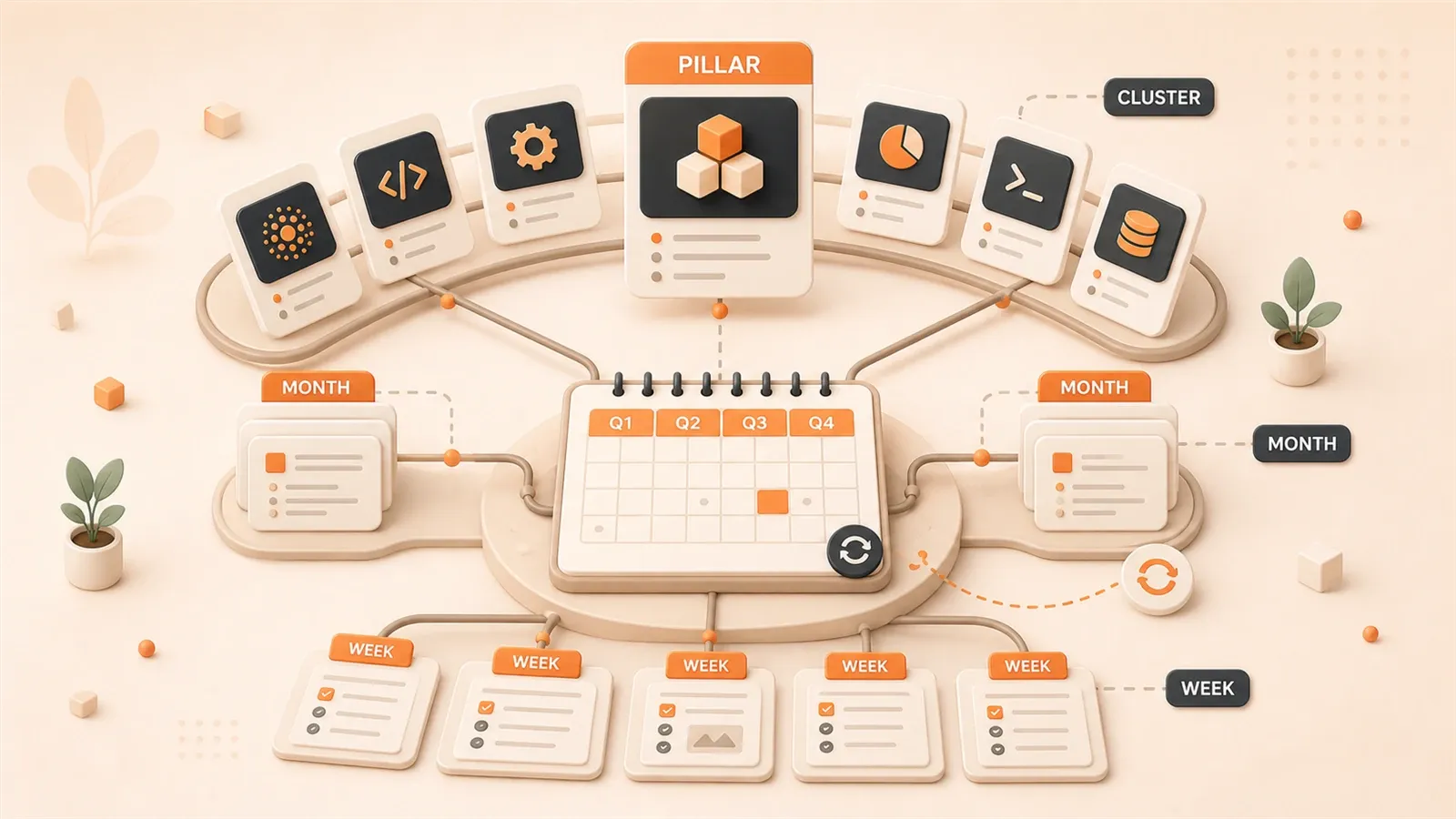
Last December, I opened my blog analytics dashboard and stared at the scattered article titles. Three Docker tutorials, two React notes, four deployment troubleshooting posts, plus a few AI tool reviews I wrote on impulse. I had written plenty, but traffic stayed stuck between 2,000-3,000 monthly visitors, never breaking through.
What worried me more was that these articles were like stray cats without a home—no connection between them, readers left after one article, bounce rate stayed high. I spent three days digging through Ahrefs and Google Search Console data before realizing the problem: my content had no structure. Search engines couldn’t figure out what authority this blog was trying to build.
This article covers how quarterly content planning and the Pillar-Cluster method transformed my blog from “write whatever comes to mind” to “grow with purpose.” These methods tripled my organic traffic in six months, and I hope they help you too.
Why Technical Blogs Need Quarterly Content Planning
Honestly, I used to hate the word “planning.” Blogs should be spontaneous, right? Write what you feel, that’s authenticity.
But data doesn’t lie.
HubSpot’s research shows that businesses publishing 16+ articles per month get 3.5 times more traffic than those publishing under 4. Ahrefs found similar results: websites publishing 2-4 new articles weekly see the fastest organic traffic growth, reaching 78% increase.
The logic is simple: search engines prefer “reliable” websites. Google’s QDF (Query Deserves Freshness) mechanism prioritizes sites that update consistently with in-depth content. Publish one article today, then skip a month, and search engines think your site isn’t trustworthy—crawler visits drop too.
The bigger problem is isolated articles. I wrote a Docker image optimization article that ranked well, but since it sat alone with no supporting Docker content, search engines struggled to judge whether my site had “authority” in the Docker space. This is exactly what Pillar-Cluster theory solves—using interconnected article series to build topical authority signals.
Technical blogs have another unique challenge: technology evolves fast. React 19 launched, Astro 5 added new features—if you don’t plan ahead, writing about these after the hype fades is pointless. Quarterly planning lets you reserve “hot topic slots” so you can publish relevant content within two weeks of a version release.
Four-Layer Planning Framework: From Annual Themes to Weekly Production
Alright, enough about why. How do you actually do it?
I use a four-layer planning framework, breaking things down from broad to specific. Think of it as a funnel: annual direction at the top, specific weekly tasks at the bottom.
Annual Themes: Define 3-5 Core Directions
At the start of each year, I spend half a day thinking about my blog’s core directions. Not too many—3-5 is enough. My themes this year: cloud services practical guides, AI development tools, frontend engineering, content operations methods.

These four themes cover areas I know well, with natural connections between them. Cloud deployment uses Docker, AI tools involve API calls, frontend engineering and cloud deployment are frontend-backend related—this combination creates natural internal links.
Quarterly Pillars: 1-2 Focus Areas Per Quarter
With annual themes set, quarterly pillars come naturally. Q1 focuses on beginner content, Q2 on deep practical guides, Q3 on industry case studies, Q4 on ecosystem building.
This isn’t rigid. If AI is hot this year, I might add an AI pillar mid-quarter. Quarterly planning prevents you from realizing later that your articles are scattered everywhere.
Monthly Brief: Weekly Article Topic List
Each month I create a simple table: what to write week 1, week 2, reserving a few “hot topic slots.” For example:
| Week | Planned Topic | Keywords | Type | Status |
|---|---|---|---|---|
| W1 | Docker Image Optimization | Docker image optimization | New article | Published |
| W2 | Docker Log Management (update old) | Docker logs | Update old | Planning |
| W3 | Cloudflare Workers Intro | Workers tutorial | New article | Planning |
| W4 | Hot topic slot | - | Reserved | TBD |
This table doesn’t need to be complex—just clear enough to know what’s next.
Weekly Production: Fixed Rhythm, Build Habit
Every week I set two tasks: one new article plus two old article updates. New articles are “offense,” old article updates are “defense.” Only offense without defense means old content sleeps; only defense without offense means slow traffic growth.
Speaking of old article updates, this is an overlooked SEO strategy.
Pillar-Cluster Methodology: Series Content Structure
Pillar-Cluster, translated as “pillar-cluster” structure. Sounds academic, but it simply means giving your articles a “home.”
What is a Pillar Page?
A pillar page is a comprehensive guide on a core topic. Articles like “Docker Practical Guide” or “React Complete Handbook.” It doesn’t need every detail, but gives readers a complete map.
My blog’s “Docker Practical Guide” series is a pillar page. It covers Docker basics, image management, container orchestration, production deployment—each module linking to more specific articles.
What is a Cluster Page?
Cluster pages are sub-topic articles supporting the pillar. Articles like “Docker Image Optimization,” “Docker Compose Intro,” “Docker Log Management”—each stands alone but links back to the pillar.
What’s the benefit? Search engines see: this site has many Docker articles, they’re interconnected, meaning the author has depth in Docker. That’s a topical authority signal.
How to Plan Internal Links?
My method is straightforward:
Step 1: Identify Core Topics. Use SEMrush or Ahrefs to check which keywords have search volume and match your expertise. I chose Docker because I use it daily and search volume is stable.
Step 2: Map Sub-Topic Clusters. Break core topics into sub-topics. Docker can split into: basics, image management, network config, data persistence, production deployment, monitoring logs. Each sub-topic is a cluster.
Step 3: Plan Internal Links. Each cluster article needs at least two links: one to the pillar page, one to related cluster articles. The pillar page links to all cluster articles.
Step 4: Continuously Expand. Each quarter, add new cluster articles to existing pillars. I recently added “Container Security Best Practices” to my Docker series.

Here’s an example: my blog has a “Docker Practical Guide” pillar with 18 cluster articles. At the start of each cluster article, I add: “This article is part of the Docker Practical Guide series. If you’re new to Docker, start with [Docker Basics Intro].” Readers know there’s more content, and search engine crawlers discover the whole series through these links.
Old Article Update Strategy: Wake Up Sleeping Content
I’ve used this strategy for six months with surprising results.
I thought SEO only came from new articles. Then Google’s John Mueller mentioned in a Q&A: updating 3 old articles has SEO value roughly equal to publishing 1 new quality article—provided updates reach 30% or more.
"Updating 3 old articles has SEO value roughly equal to publishing 1 new quality article—provided updates reach 30% or more"
What’s 30%? If you have an 800-word article, rewriting 250+ words triggers this effect. Fixing a few typos or swapping an image isn’t enough—you need substantial content changes.
Backlinko has a case that illustrates this well: they expanded an 800-word short article to 2,500 words, adding 12 data charts. Single article traffic jumped 611%. That number sounds extreme, but the logic holds: search engines like deep, data-backed content.
How to Identify Old Articles Worth Updating?
Each week I use Google Search Console to filter articles with declining rankings. Ranking drops might come from: outdated content, competitors writing better articles, or changed search intent. These become my “update pool.”
Also, I regularly check articles over 1 year old. Technical content ages fast—React 18 best practices might not apply after React 19 launches, prioritize these.
What to Change When Updating?
I use a simple checklist:
- Title optimization: Check if original title keywords still have search volume, switch to new keywords if needed
- Data updates: Original data might be outdated, replace with latest
- Case additions: Add a recent practical case proving content still works
- Internal links: Check if new series articles can link here
Each week: update 2-3 old articles, publish 1 new article. New is offense, updates are defense. Combine both for stable traffic growth.
Technical Blog Special Considerations
Technical blogs face a challenge other niches don’t: technology evolves too fast.
When React 19 launched, my Twitter flooded with discussions. Two weeks later, blogs published “React 19 New Features” and “React 19 Migration Guide” articles. Without pre-planned topic slots, writing after hype fades means readers stop caring.
Tech Version Iteration Topic Rhythm
I reserve 1-2 “hot topic slots” in quarterly plans. For Q2, I leave week 3 and 4 slots marked “TBD—waiting for tech hot topics.”
Once a major version releases (React 19, Astro 5, Node.js 22), within two weeks I publish an intro guide. Doesn’t need depth—just help readers quickly understand “what’s new” and “worth upgrading?”
Series Continuation Strategy
If you have an existing series (like my 18-article Docker guide), how do you keep producing without losing readers?
My experience: don’t let series article gaps exceed one month. Beyond that, readers forget earlier content, reading continuity breaks.
Also, at the end of each series article, I preview the next: “Next week we’ll cover Docker network configuration, stay tuned.” Readers have expectations, more likely to subscribe or bookmark.

Practical Templates and Tool Recommendations
Finally, sharing templates and tools I use daily.
Quarterly Planning Excel Template
If you prefer Excel, create a table like this:
| Week | Publish Date | Article Title | Target Keyword | Type | Status |
|---|---|---|---|---|---|
| W1 | 2026-05-05 | Docker Image Optimization | Docker image optimization | New article | Published |
| W2 | 2026-05-12 | Docker Log Management Update | Docker log management | Update old | Updated |
| W3 | 2026-05-19 | Cloudflare Workers Intro | Workers tutorial | New article | Planning |
| W4 | 2026-05-26 | Hot topic slot | - | Reserved | TBD |
I open this table weekly to know what’s next.
Editorial Calendar Tools
If Excel isn’t your style, try Notion, Asana, or Lark multi-dimensional tables. Benefits: tags, reminders, collaborative editing. I use Lark because mobile experience is good—can check topic status during commute.
SEO Tool Integration
Content planning needs data, not just intuition. My workflow:
- Use SEMrush or Ahrefs to search target keywords, check volume and competition
- List keywords with volume >500 and medium-low competition into candidate pool
- Combine with my expertise to select final topics
After keyword research, fill data into the planning table’s “Target Keyword” column. This reminds you which keywords to cover when writing.
Conclusion
After all this, the core is three things:
First, quarterly planning gives content direction. With quarterly pillars, weekly topics have clear goals—no more “write randomly, look back at scattered pieces.”
Second, Pillar-Cluster structure builds topical authority. Connecting pillar pages with cluster articles shows search engines you have depth in a field, traffic naturally rises.
Third, combining new and old article strategies maximizes SEO value. Weekly one new article plus two old updates—offense and defense together for stable growth.
Start this week: grab a blank paper, write 3-5 core themes for your blog, then plan next quarter’s pillar topics. Planning isn’t about limiting creativity—it’s about letting creativity grow with purpose.
If you’ve read the content marketing funnel and data analysis articles in the Content Marketing Guide series, this article connects planning with operations strategy. Next, we’ll cover content data analysis—using data feedback to adjust topic strategy.
FAQ
What blog size suits quarterly content planning?
How many articles does Pillar-Cluster need to work?
Is updating old articles really more effective than writing new ones?
What's the best timing window for tech hot topic response?
How long before series article gaps lose readers?
Any recommended content planning tools?
10 min read · Published on: Apr 30, 2026 · Modified on: Jul 14, 2026

Content Marketing Complete Guide
You are reading the opening post of this series. Continue to the next post or open the full series hub to scan the whole path.
Previous
You are at the beginning of this series.
Next
Series Updates and Hot Topic Patches: Practical Strategies to Keep Your Tech Blog Alive
Explore strategies for series updates and hot topic patches for tech blogs, with actionable workflows to maintain blog vitality, respond quickly to trends, and boost SEO performance.
Part 2 of 26


Comments
Sign in with GitHub to leave a comment